Cause Marketing Strategy: Why Profit and Purpose Belong Together
Cause marketing isn't charity — it's one of the most effective brand strategies in history. Here's what Singapore SMEs need to know to build one that actually works.

In four months, American Express raised $2 million for the Statue of Liberty restoration — and watched card usage surge 28%. New cardholders exceeded projections by 17%. They didn't call it charity. They called it cause marketing, and the phrase has been with us ever since.
That was 1983. Today, cause marketing is a $1.78 billion industry in North America alone. But most businesses — especially small and medium-sized ones — still treat it like a nice-to-have: something large corporations do with large budgets to generate good press and appease shareholders. That's a mistake, and it's costing them customers, talent, and market share.
This post breaks down what a cause marketing strategy actually is, where it came from, why it produces measurable business results, and what Singapore SMEs can do to build one that genuinely benefits both their bottom line and the community around them. Explore more brand and marketing strategy on our blog.
What Cause Marketing Is — and What It Isn't
Cause marketing is when a for-profit brand partners with a non-profit organisation for mutual benefit. That last part — mutual benefit — is what makes it different from everything else it gets confused with.
It is not philanthropy. Philanthropy is when a company writes a cheque and asks for nothing in return. Cause marketing asks for something in return, explicitly and without apology: more customers, greater brand visibility, deeper loyalty, or entry into a new market.
It is also not a public service announcement (PSA). A PSA promotes awareness for a social issue — think Smokey the Bear and forest fire prevention, or road safety campaigns aimed at school children — but it carries no commercial tie-in. There is no product, no purchase trigger, no revenue linked to the message.
Cause marketing sits at the intersection: an unashamedly for-profit brand joins forces with an unequivocally good non-profit organisation, and both walk away with something they needed. When it works, it works because the partnership is structured — not sentimental. Each side brings something the other can't easily generate alone, and the campaign is designed to deliver results for both.
Understanding this distinction changes how you approach building one. You're not making a donation with a logo attached. You're running a campaign with shared goals, aligned audiences, and accountability on both sides.
Where It Started: The Campaign That Proved the Model
The year was 1976. The Marriott Hotel Corporation was preparing to open a 200-acre family theme park called Marriott's Great America in Santa Clara, California. Bruce Birch, Marriott's PR director — and widely credited as the father of cause marketing — had a question worth asking: what if the best way to launch a commercial venue was through a non-profit partner?
He interviewed over 20 charities. He found his match in the March of Dimes, an organisation dedicated to improving the health of children. The alignment was immediately obvious: Marriott was building a family entertainment destination; the March of Dimes served families and children. Both organisations needed something the other could provide — Marriott needed maximum publicity and community goodwill ahead of its launch, and the March of Dimes needed to motivate donors to deliver their pledges on time.
Birch designed a solution that addressed both needs simultaneously. He created a contest where the individual or team who raised the most money for the March of Dimes by a set deadline would win a trip to the park's opening for themselves and 100 friends. The contest rolled out across 67 cities throughout the western United States. Because the March of Dimes was so connected to families and schools, the excitement spread quickly — children brought pledge sheets home, parents engaged, teachers promoted it in classrooms.

The results were extraordinary. The March of Dimes raised $2.5 million more than expected — 40% more than they had ever raised in their entire history. Marriott's new complex attracted over 2.2 million visitors in its first year, a record-breaking attendance for a regional theme park at the time.
Two organisations. Separate goals. One campaign. Mutual benefit. That is cause marketing in its purest form.
The Rule That Makes or Breaks Every Cause Marketing Strategy
Seven years after Marriott's launch, American Express wanted to achieve two things: increase card usage among existing customers and sign up new cardholders. At the same time, the Statue of Liberty needed significant restoration work. American Express proposed a simple mechanism: every purchase made on an AmEx card during the campaign would trigger a two-cent donation to the Statue of Liberty Restoration Project, and every new card member would generate a $1 donation.
The result was $2 million raised in four months, a 28% surge in card transactions, and 17% more new cardholders than the company had projected. Relations between American Express and its merchant partners improved markedly as well.
When journalists asked what to call this kind of initiative, American Express said: cause marketing. The phrase stuck.
What made both the Marriott and AmEx campaigns work was the same underlying principle: alignment. Marriott was a family-oriented entertainment brand partnering with an organisation that served the health of children. American Express had a documented history with the Statue of Liberty stretching back to 1885, when company employees contributed money to build the pedestal. Beyond the history, the business logic was sound: when historic landmarks are restored, tourism rises, local economies revive, and American Express — whose business depends on consumer spending in those places — benefits directly.
The alignment wasn't cosmetic. It was structural. And that is the first rule of any cause marketing strategy worth building: the partnership must make sense in business terms, not just ethical ones. A mismatch between brand and cause doesn't just underperform — it damages trust. Consumers are skilled at detecting when a partnership was assembled for optics rather than genuine shared interest.
Why Consumers Are Now Demanding It
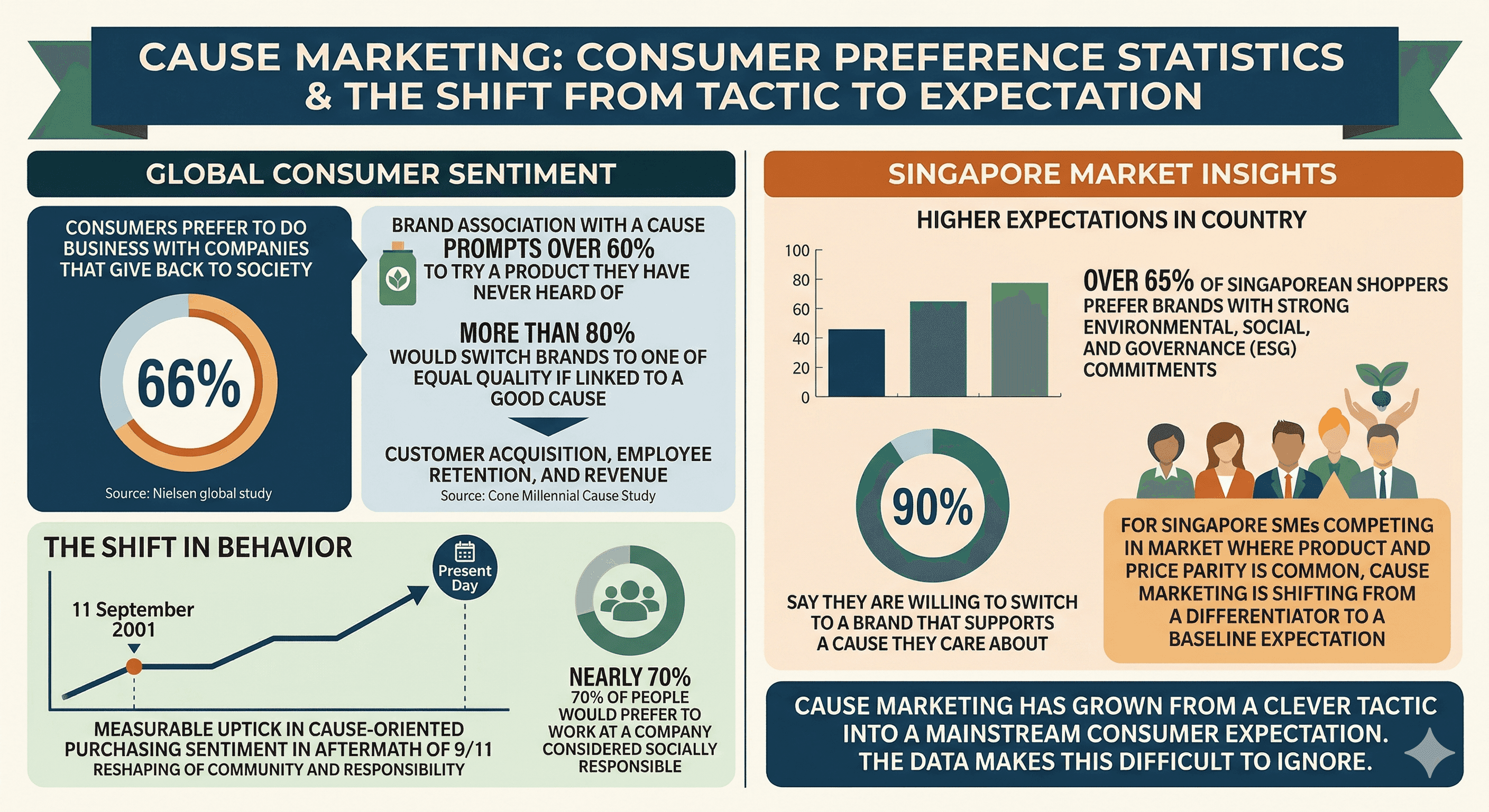
Cause marketing has grown from a clever tactic into a mainstream consumer expectation. The data makes this difficult to ignore.
According to a Nielsen global study, 66% of consumers prefer to do business with companies that give back to society. Research from the Cone Millennial Cause Study found that a brand's association with a cause will prompt over 60% of shoppers to try a product they have never heard of — and more than 80% would switch from one brand to another of equal quality if one was linked to a good cause. Nearly 70% of people say they would prefer to work at a company considered socially responsible.
These are not soft sentiment numbers. They translate directly into customer acquisition, employee retention, and revenue.
That shift in consumer behaviour has a surprisingly specific start date: 11 September 2001. Researchers and marketers have traced a measurable uptick in cause-oriented purchasing sentiment to the aftermath of the 9/11 attacks, a moment that reshaped how entire generations think about community, responsibility, and who deserves their loyalty and spending power.
In Singapore, the expectations run even higher. Over 65% of Singaporean shoppers prefer brands with strong Environmental, Social, and Governance (ESG) commitments, and 90% say they are willing to switch to a brand that supports a cause they care about. For Singapore SMEs competing in a market where product and price parity is increasingly common, cause marketing is shifting from a differentiator to a baseline expectation.
The implication for your digital marketing is direct: the story your brand tells — and the cause it chooses to champion — is now a meaningful variable in whether customers choose you, recommend you, and stay with you. If you want to explore how to build this into your strategy, Uniqode's digital marketing team works with Singapore businesses to develop campaigns that connect commercial goals to community impact.
The Lesson Bono Learned the Hard Way
Not every cause marketing campaign succeeds. Some fail in a way that is instructive.
In the early 2000s, U2 frontman Bono and his wife Ali Hewson founded EDUN — a for-profit fashion brand built on the principle of "trade for aid." The idea was to source materials and craftsmanship from Africa, create sustainable jobs across the continent, and demonstrate to the fashion industry that doing business ethically in Africa was commercially viable. The cause was genuine, the mission was clear, and the founders were among the most recognisable names in the world.
The clothing didn't sell. Not because the cause was wrong, but because the product wasn't strong enough to stand on its own. Consumers were interested in design and fit first, social mission second. Sales collapsed.
"We focused too much on the mission in the beginning," Ali Hewson said. "But it's the clothes, it's the product, it's a fashion company. It needs to be first and foremost."
Cause marketing expert Joe Waters, whose work at selfishgiving.com is essential reading for anyone building in this space, frames it this way: the only place cause comes before product, marketing, social media, community, and distribution is in the dictionary. You have to do the hundred other things well before cause enters the picture. But when it does, it makes everything better.
Bono took the lesson and applied it. He and partner Bobby Shriver launched Product RED — a licensing model where iconic companies including Nike, Apple, American Express, Starbucks, and Armani created special red-themed merchandise. Nike designed shoes with red laces. Apple produced red iPods. American Express issued a red card. Armani created red clothing and jewellery. A portion of the profits from every purchase went to Bono's RED organisation, which sent 100% of that revenue to global health programmes fighting AIDS, tuberculosis, and malaria in Africa.
Product RED led with great products. The cause was the multiplier, not the foundation. To date, it has raised over $215 million and helped more than 14 million people access life-saving treatment. The goal — the virtual elimination of mother-to-child HIV transmission — is an ambition built entirely on the back of profitable commerce.
Profit is not the enemy of purpose. It is what makes purpose sustainable.
What Singapore SMEs Can Do This Week

You do not need a $25 million budget or a celebrity co-founder. The Home Depot invested that much because it could — but the principle behind its partnership with KaBOOM!, the non-profit that built 1,000 playgrounds in 1,000 days and reached over 600,000 children, is available to any business of any size.
The principle is this: find a cause whose audience is your audience, structure the partnership so both sides gain something concrete, lead with your product, and measure it like a campaign.
Here is how to put that into practice:
1. Map your customer to a cause. Start with your existing customers — who they are, what they care about, what problems they face beyond the ones you already solve. A digital marketing agency whose clients are in retail and food and beverage might find natural alignment with a Singapore food security charity. A brand serving young professionals might partner with a mental health or youth development organisation. The overlap needs to be genuine. Customers recognise manufactured alignment quickly, and it does more damage than no alignment at all.
2. Define what each side brings. The non-profit brings credibility, a mission-driven audience, and a cause worth rallying around. You bring marketing expertise, reach, and funding. Be specific before the campaign launches: are you committing a percentage of revenue from a specific product or campaign window? A set number of volunteer hours from your team? A co-branded content series? Vague partnerships produce vague results. Clear commitments produce clear metrics.
3. Measure it like the business campaign it is. Set Key Performance Indicators (KPIs) before launch. Track brand awareness lift, customer acquisition cost, social engagement, and conversion rates alongside the fundraising numbers. Report results transparently — to your customers, to your non-profit partner, and internally. Transparency is what separates cause marketing from cause-washing, and consumers in 2025 are sophisticated enough to tell the difference. According to recent research, 86% of consumers want more detail about what companies are actually doing, not just that they claim to care.
4. Lead with your product or service. Whatever you are selling — digital marketing services, a physical product, a content subscription — it has to be strong enough to stand alone. The cause makes a good product better. It cannot rescue a weak one. Get the quality right first, then introduce the cause as the layer that turns customers into advocates.
If you're not sure where to start, or want help translating this into a concrete campaign plan, our digital marketing team at Uniqode Creative is happy to work through what a cause marketing strategy could look like for your business.
Profit Is Not the Enemy of Purpose
Here is the part that makes some people uncomfortable — and the part that makes cause marketing work at scale.
Profit is what makes it sustainable.
Cause marketing has grown from $120 million in total North American spend in 1990 to $1.78 billion in 2013. That growth was not driven by altruism. It was driven by the fact that businesses found a strategy that helped them acquire customers, build loyalty, enter new markets, and differentiate in crowded categories — while simultaneously funding organisations doing genuinely important work in communities they both serve.
KaBOOM built 1,000 playgrounds and reached 600,000 children because The Home Depot invested $25 million, supplied materials and expertise, and contributed nearly 100,000 staff members who donated over 950,000 volunteer hours. That investment made hard business sense: it gave Home Depot a way to introduce itself to new communities with goodwill already established, turning a store opening into a community event. The cause benefited directly because the business saw a clear return.
That reframe matters for Singapore SMEs. You are not choosing between growing your business and supporting your community. A well-designed cause marketing strategy lets you do both — and your customers, your team, and the community around you are increasingly asking you to.
The best cause marketing campaigns in history were not built on sacrifice. They were built on alignment, structure, a great product, and the understanding that doing good and doing well are not opposites — they are, when you get the execution right, the same thing.
Digital Marketing
Ready to grow your online presence?
From SEO and social media to paid ads — we build digital marketing strategies that deliver measurable results.