How We Use an AI Content Pipeline to Write This Blog Post
This blog post was created using the same AI content pipeline it describes. Here is a plain-English look at how we combine AI drafting with human editing to produce quality content — and how your business can do the same.

This blog post was written using an AI content pipeline. Not in the way you might think — no one typed "write me a blog post" into ChatGPT and hit publish. There is a system behind it. A structured workflow that uses artificial intelligence at specific stages while keeping a human in the driver's seat at every decision point.
And that is exactly what we are going to walk you through today.
94% of marketers now plan to use AI in their content creation process, according to HubSpot's 2026 State of Marketing Report. But there is a massive gap between "using AI" and using it well. Most businesses are either ignoring AI entirely or using it without any structure — and both approaches leave value on the table.
If you have ever struggled to publish content consistently, felt like your blog was always six posts behind schedule, or wondered whether AI could actually help without making everything sound robotic, this post is for you.
The Content Problem Most Businesses Actually Have

Let us be honest about what content marketing looks like for most small and mid-sized businesses.
You know you need a blog. You know content drives organic traffic, builds trust, and supports your sales conversations. But between running your business, managing your team, and everything else on your plate, writing a 2,000-word article is not exactly at the top of your priority list.
The usual options are not great either. Hiring a full-time content writer in Singapore can cost upwards of S$4,000 per month. Engaging a marketing agency often starts at S$5,000–8,000 monthly. And doing it yourself means late nights, inconsistent publishing, and articles that never quite hit the mark.
Here is the real kicker: research shows that fully human content still generates 5.4 times more organic traffic than generic, unedited AI content. So you cannot just hand the keys to a chatbot and walk away. But you also cannot afford to spend 8–10 hours on every blog post.
This is the tension an AI content pipeline is designed to resolve.
If you are already thinking about how a system like this could work for your business, our team at Uniqode Creative can help you figure that out.
What Is an AI Content Pipeline, in Plain Terms?

Forget the jargon for a moment. An AI content pipeline is simply a step-by-step process for creating content, where AI handles the heavy lifting and a human handles the thinking.
Think of it like a kitchen. AI is your sous chef — it can chop vegetables, prepare ingredients, and even suggest recipes. But the head chef (you) decides what goes on the menu, tastes the dish before it goes out, and makes the final call on quality.
In practical terms, it means:
- AI generates options, you choose. Instead of staring at a blank page, you start with 10 topic ideas the system has already researched.
- AI drafts, you shape. The first draft comes together in minutes, not days. But you review every section, adjust the tone, add your expertise, and cut what does not fit.
- AI optimises, you approve. SEO metadata, keyword placement, and internal linking are suggested automatically. You check that it actually makes sense before anything goes live.
The key word here is "pipeline" — it is not a single tool or a one-click solution. It is a sequence of stages, each with a clear handoff between AI and human.
How Our Content Pipeline Works: 7 Steps From Idea to Published Post
Here is how we built ours — the same system that produced the post you are reading right now.
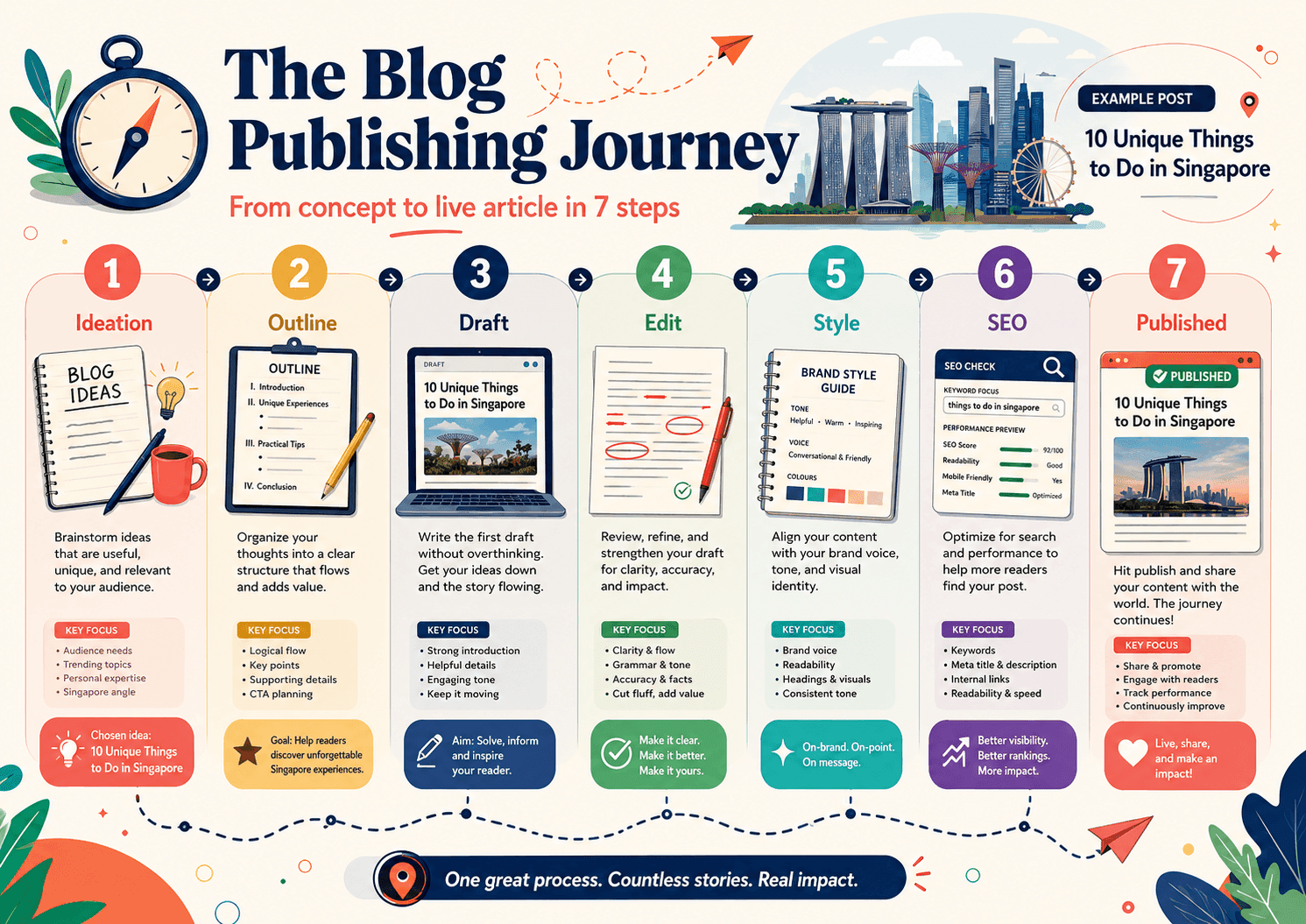
Step 1: Ideation
Everything starts with a topic. You can feed the pipeline a keyword, a theme, or even a podcast transcript, and it generates a shortlist of content ideas. Each idea comes with a suggested angle, a target keyword, and a rationale for why it could rank.
For this particular post, the idea was straightforward: write about the pipeline itself. Meta, yes. But also genuinely useful — because the best way to show how something works is to use it.
Step 2: Research
Before a single word of the article is written, the pipeline does market research. It looks at what is already ranking for the target keyword, identifies gaps in existing content, and pulls in recent statistics from credible sources.
For this post, it found the HubSpot data on AI adoption, the Singapore-specific cost benchmarks, and the research comparing human versus AI content performance. That research shaped the angle you are reading now — not another generic "AI is changing marketing" piece, but a practical, show-don't-tell walkthrough.
Step 3: Outline and Format Selection
The pipeline recommends a content format — blog post or resource guide — based on the depth of the source material. It generates a section-by-section outline and presents it for approval before drafting begins.
This is a critical checkpoint. The outline is where you catch structural problems early, before anyone (human or AI) has invested time writing 2,000 words in the wrong direction.
Step 4: Drafting
This is where AI does its heaviest work. Using the approved outline, the research findings, and the brand voice guidelines baked into the system, it generates a full first draft.
But — and this is important — it is a first draft. It is structured, it is coherent, and it is grounded in real data. But it still needs a human pass to add nuance, cut fluff, and make sure it actually sounds like something your business would say.
Step 5: Human Review
Every draft goes through a review stage where a real person reads the content, edits it, checks the facts, and adjusts the tone. This is non-negotiable.
The hybrid approach — AI draft plus human editing — performs 127% better than raw AI output. That is not a marginal improvement. It is the difference between content that ranks and content that gets ignored.
Step 6: SEO and Metadata
Once the content is finalised, the pipeline generates SEO metadata: title tags, meta descriptions, URL slugs, and tags. It also checks that the primary keyword appears in the right places — the headline, the first paragraph, and at least two subheadings.
This is the kind of work that is easy to skip when you are doing everything manually. In the pipeline, it happens automatically.
Step 7: Publish and Promote
The reviewed draft gets pushed to our content management system as an unpublished post, ready for a final check in the CMS before going live. After publishing, the pipeline can also generate social media posts for LinkedIn, Instagram, and X — giving you a promotion kit alongside every article.
Why "Human-in-the-Loop" Is Not Just a Buzzword

There is a reason we designed every stage of this pipeline with a human checkpoint.
Consumers are getting better at recognising AI-generated content. And more importantly, they are tuning it out. HubSpot's research points to a clear trend: audiences are gravitating toward content that feels genuinely human — toward newsletters, podcasts, and articles that carry a real perspective.
AI-only content tends to be correct but bland. It covers the topic without saying anything new. It reads like a Wikipedia summary with better formatting.
The pipeline avoids this by treating AI as the engine and the human as the navigator. The AI gets you from zero to first draft in a fraction of the time. The human makes sure the destination is actually worth arriving at.
This approach is especially relevant for Singapore businesses. With content marketing costs running high and competition for organic traffic increasing, a structured pipeline gives you the output of a content team at a fraction of the cost. [See how Uniqode Creative approaches this for our clients](https://uniqode.sg/#services).
What This Means for Your Business
You do not need to build your own content pipeline from scratch to benefit from this approach. But there are a few principles you can apply right now:
Start With Structure, Not Tools
The biggest mistake businesses make with AI content is jumping straight to the tool without defining the process. Before you pick a writing assistant, map out your content workflow: who decides topics, who reviews drafts, who handles SEO, and who approves the final version.
Use AI for the Parts That Slow You Down Most
For most teams, the bottleneck is not ideas — it is execution. Research takes hours. First drafts take days. SEO optimisation gets skipped because there is no time. These are exactly the stages where AI adds the most value.
Never Publish Without a Human Review
This is the one rule that should not be flexible. Every piece of AI-assisted content needs a human pass. Not just a quick skim — a proper read where someone with subject-matter knowledge checks the facts, adjusts the voice, and asks whether this is something they would be proud to put their name on.
This Post Was Built by the Pipeline It Describes
Every step we walked through above is exactly what happened behind the scenes to create this article. The research, the outline, the draft, the review — all of it flowed through the same system.
That is the point. A good content pipeline is not theoretical. It is a working process that produces real output, consistently, without burning out your team or blowing your budget.
The AI content market is projected to reach $57.99 billion in 2026. The businesses that benefit will not be the ones using AI the most — they will be the ones using it the most intentionally.
If you have been thinking about how to make content marketing more sustainable for your business — whether that means publishing more consistently, improving your SEO, or simply freeing up time for the work that only you can do — we would like to help.
Get in touch with Uniqode Creative and let us show you how a content pipeline could work for your business. We will walk you through the process, help you set it up, and make sure it actually fits the way your team works. No generic templates. No one-size-fits-all. Just a system that makes good content easier to produce.
Work with us
Let's grow your business together
From strategy to execution, Uniqode Creative handles your brand while you focus on what you do best.